石墨烯改性超高性能混凝土综述
李子豪1, 于峰2, 李洪艳3, 王欣悦4,*, 韩宝国5,*
(1. 大连理工大学土木工程学院, 大连 116024
2. 大连理工大学土木工程学院, 大连 116024
3. 东南大学材料科学与工程学院, 南京 211189
4. 天津大学建筑工程学院, 天津 300072
5. 大连理工大学土木工程学院, 大连 116024)
摘要: 石墨烯作为二维纳米碳材料, 既具有优异的力学性能, 又具有优异的电导率和热导率, 同时密度低、热稳定性和化学稳定性好, 将其与超高性能混凝土 (Ultra-high performance concrete, 简称UHPC) 复合, 有望发展兼具优异力学性能、耐久性能和多功能/智能性能的结构-功能一体化UHPC。本文系统梳理了石墨烯改性超高性能混凝土的研究进展, 首先探讨了不同种类石墨烯材料特性及其分散技术, 然后分析了石墨烯改性超高性能混凝土的早期理化性能 (如水化性能、流变性能、工作性能) 以及凝结硬化后的性能 (如静态/动态力学性能、耐久性及多功能/智能特性) , 最后总结讨论了石墨烯改性UHPC后续发展面临的挑战和发展策略。该综述有助于推动石墨烯改性UHPC的研究, 并为混凝土材料的可持续发展提供指导。
关键词: 石墨烯, 超高性能混凝土, 分散, 流变性能, 力学性能, 多功能/智能
DOI: 10.48014/ems.20250317001
引用格式: 李子豪, 于峰, 李洪艳, 等. 石墨烯改性超高性能混凝土综述[J]. 工程材料与结构, 2025, 4(2): 5-29.
文章类型: 综 述
收稿日期: 2025-03-17
接收日期: 2025-03-25
出版日期: 2025-06-28
1 引言
混凝土作为现代建筑中应用最广泛的工程材料,凭借其低成本、良好可塑性和抗压性能有力支撑了城市化进程的快速发展[1,2]。然而,传统混凝土存在低拉伸强度与高脆性的固有缺陷,易引发结构裂缝,并在腐蚀环境中加速碳化、氯离子侵蚀等耐久性劣化过程,显著缩短服役寿命并增加维护成本[3-5]。随着现代基础设施向巨型化、环境严酷化、多功能化及可持续化方向演进,研发兼具超高性能、优异耐久性、多功能特性和环境友好性的新型混凝土材料已成为工程领域的必然需求。超高性能混凝土(Ultra-high performance concrete,UHPC)作为新一代建筑材料,通过低水胶比(0.15~0.25)、高颗粒堆积密度(0.825~0.855)体系设计,结合增强纤维(体积掺量≥2%)与高效减水剂等关键技术,实现了材料性能的突破性提升[6-10]。UHPC在基体堆积密度、均质性以及裂缝控制上的显著提升,提高了UHPC的力学性能、耐久性以及丰富了UHPC的多功能性[11-13],这些特性使其在极地环境、海洋工程和军事防护等严苛环境展现出巨大的应用价值[14-17]。然而,UHPC仍存在基体脆性和微裂缝难以监测的技术瓶颈,在复杂应力与环境耦合作用下可能引发灾难性破坏[9,18]。
复合纳米材料为UHPC性能优化提供了新路径[19]。研究表明,纳米材料会改善其微观结构及界面过渡区(Interfacial Transition Zone,ITZ),进而提高基体的力学性能和耐久性[20]。此外,具有特殊性质的纳米材料还可以改善UHPC多功能特性[21]。在众多纳米材料中,碳基纳米材料具有显著特性优势,通常根据其维度分为零维(富勒烯)、一维(碳纳米管)和二维(石墨烯),其中,石墨烯及衍生物因兼具超高强度、卓越导电性与化学稳定性,成为制备结构-功能一体化水泥基复合材料的研究热点[22]。石墨烯改性UHPC通过跨尺度协同效应实现性能突破:在微观层面,石墨烯可定向调控水化产物,促进水化硅酸钙(Calcium Silicate Hydrate,C-S-H)凝胶致密化[20];在宏观层面,其二维片层结构通过转移裂纹开展与桥接机制显著提升断裂韧性[23]。研究还发现,0.05wt.%掺量的氧化石墨烯可使UHPC的抗压强度提升20%[24]。此外,石墨烯可均化内部水化热,减少温度裂缝产生,降低早期开裂风险[25,26]。已有研究报道,石墨烯复合UHPC表现出更好的改性效果,凭借其更高的力学性能和更好的抗裂能力,大大延长了结构的耐久性,降低了维护成本[27]。值得注意的是,石墨烯改性UHPC在自感知灵敏度(电阻变化率0.5~2%/MPa)和损伤定位精度(<5mm)方面的突破,为智能监测系统的集成提供了可能[2,28]。然而,石墨烯的超高比表面积、强范德华力以及疏水表面特性使其难以在水溶液或其他常用溶剂中分散,严重制约其性能发挥[29,30]。分散石墨烯并保持其稳定性,是实现其在UHPC中发挥改善作用的前提。现有对石墨烯的分散方法包括物理方法(高剪切混合、球磨法、超声处理),化学方法(表面活性剂等)以及物理化学协同的方法(超声、球磨配合高效减水剂等)[31]。将石墨烯分散并掺入UHPC有望突破UHPC的性能瓶颈,更好的应对脆性和耐久性的挑战以及满足建筑智能化的需求[32-38]。
因此,本文系统梳理了石墨烯改性UHPC的研究进展,首先探讨了不同种类石墨烯及其分散制备技术,然后分析了石墨烯改性UHPC的早期理化性能(包括水化、流变性能、工作性能)以及凝结硬化后的性能(如力学性能、耐久性及多功能/智能特性),最后总结和讨论了石墨烯改性UHPC面临的主要问题及展望。该综述有助于推动石墨烯改性UHPC的研究,并为UHPC的可持续发展提供理论指导。
2 石墨烯
2.1 石墨烯种类及特性
石墨烯(Graphene)是一种由碳原子以sp2杂化轨道组成的单原子层二维材料,其结构为蜂窝状六边形晶格,因具备超高比表面积(2630m2/g)、优异力学强度(拉伸强度130GPa,杨氏模量1.1TPa)以及卓越导电/导热特性(导热系数~5000W·m-1·K-1,电子迁移率2 × 105cm2·V-1·s-1),在复合材料领域展现出巨大应用潜力[39-45]。自石墨烯被发现以来,已经有不同种类的石墨烯被研制,如氧化石墨烯(Oxide graphene,GO)、还原氧化石墨烯(Reduced graphene,rGO)和石墨烯纳米片(Graphene nanoplates,GNP)。如图1所示,通过SEM/TEM图像对比显示了典型石墨烯及其衍生物的形貌特征:①Graphene[46]呈现明显的六边形晶格状;②GNP[47]呈现规整的平面层状结构;③GO[48]表面存在褶皱与官能团;④rGO[49]表面更为平整且部分恢复其共轭结构;⑤特性对比[50]则量化了不同类型石墨烯的制备成本、各项性能、分散性以及增强效率。
GO是通过Hummers法氧化插层制得的石墨烯衍生物,其表面具有羟基(-OH)、环氧基(C-O-C)等亲水官能团,易分散在水溶液中(浓度>5mg/mL),可以有效提升水泥基复合材料的界面结合强度(增幅15%~20%)与抗渗性(氯离子扩散系数降低30%),进而增强水泥基复合材料的力学性能和耐久性能[51]。然而,氧化过程导致的晶格缺陷会削弱其本征导电性(电导率下降3~5个数量级)并引发热稳定性劣化(分解温度<200℃)[52]。为减少含氧官能团造成的不利影响,研究人员通过热还原(>600℃)或化学还原工艺修复sp2杂化结构,制得rGO[53]。这在一定程度上恢复了其石墨烯的物理强度和导电性(电导率102~103S/m)[54]。rGO在还原过程中残留的部分含氧官能团,增加了其在水等溶剂中的溶解度,并可作为C-S-H晶体的异相成核位点加速水化反应[55]。相较于GO和rGO,GNP因其低成本(较化学沉积法(CVD)减少90%)与高纵横比(直径/厚度>1000)的优势,成为大规模工程应用中的优选石墨烯材料[56]。其堆叠片层结构(厚度<100nm)以及优异的力学性能(高杨氏模量(>1.1TPa)、刚度(300~400N/m)和断裂强度(125GPa))[30,57]可显著提升混凝土断裂韧性与耐久性[58],且在低掺量下,即可起到改善混凝土材料性能的作用[59]。
然而,制备高质量石墨烯的处理过程通常复杂且昂贵,不利于大规模工程应用,因此,更为经济、环保和高效的石墨烯制备方法是当前研究的关键[60]。闪蒸焦耳热(Flash joule heating,FJH)方法是一种制备石墨烯的高产率和低成本的方法。该方法于2020年提出,可以通过瞬时高压放电将无定形碳源在高温环境中有效地转化为新的六边形单层石墨烯,如图2所示,这种石墨烯被称为闪蒸石墨烯(Flash graphene,FG)[61]。与传统石墨烯相比,具有碳来源广泛,低缺陷率、碳足迹少、成本低的优点,可以作为改善材料被广泛应用到建筑工程中[62,63]。
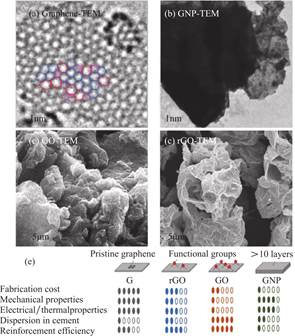
图1 多种石墨烯的SEM/TEM图像及特性对比
Fig.1 SEM/TEM images and comparative characteristics of various types of graphene
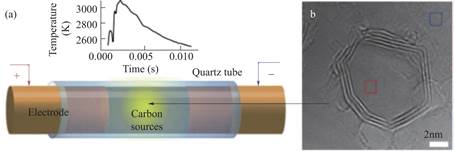
图2 闪蒸石墨烯制备流程:(a)FJH系统示意图;(b)FJH合成后样品[61]
Fig.2 Synthesis process of flash graphene:(a)Schematic diagram of FJH system;(b)Sample obtained after FJH synthesis [61]
1.2 分散方法
石墨烯的物理分散技术主要分为干法混合和湿法混合两种方式,包括机械搅拌、球磨、高剪切混合和超声处理等方法。干法混合技术通过直接将石墨烯与胶凝材料混合,在干燥状态下搅拌来实现分散[50,64]。该方法操作简单、成本低,且易于在实验室和现场快速应用,因而成为一种流行的分散方法。例如,Wang等[31]通过将砂、水泥料和rGO进行预先干燥混合搅拌,实现了较好的分散效果,进而提高了试件的力学性能,这主要归因于砂粒的剪切效应有效减少了rGO的团聚。此外,球磨技术通过碰撞产生的机械力和高能作用分散石墨烯,能够去除石墨烯表面的官能团和缺陷,从而防止团聚[65]。Jing等[66]通过在行星式球磨机中研磨水泥熟料、GO和石膏,实现了GO在水泥中的均匀分散。然而,过度的机械分散可能会对石墨烯结构造成损伤[64],为了更好地实现分散效果,研究人员还尝试利用材料物理特性,实现无损分散。如图3所示,Wang等[67]利用石墨烯的吸附性,将石墨烯与微米颗粒(如水泥等胶凝材料)预先混合处理,发现可以将其均匀吸附在水泥颗粒表面。Bai等[68]发现硅灰能够有效隔离石墨烯,还能增加石墨烯与水泥基体之间的界面强度。
湿法混合技术利用水等溶剂来分离石墨烯,并利用搅拌棒、磁转子或超声仪器将石墨烯混合在水或溶液中。其中,超声技术是一种高能高效率的分散方法,通过超声波探头产生高局部剪切力和空化气泡将石墨烯分散在水中[69-72]。Jaramillo等[73]研究发现手动搅拌(搅拌棒或钻头搅拌)产生的剪切力较低,不足以克服相邻GNP层之间的强范德华力,GNP分散体具有最低的稳定性,而超声技术显著提高了GNP分散体的稳定性。然而,长时间或高功率的超声处理可能导致石墨烯碎裂并引入缺陷,因此需合理控制超声功率和处理时间[74]。Gao等[75]进一步研究了超声时间(1~60min)和功率(55~118W)对GO分散的影响,发现GO达到一定的分散程度后,超声时间的延长对分散效果的影响减弱,同时过大的超声功率还会对GO的自身(氧化基团和碳骨架结构)产生损害,这些研究为优化超声分散工艺提供了重要指导。
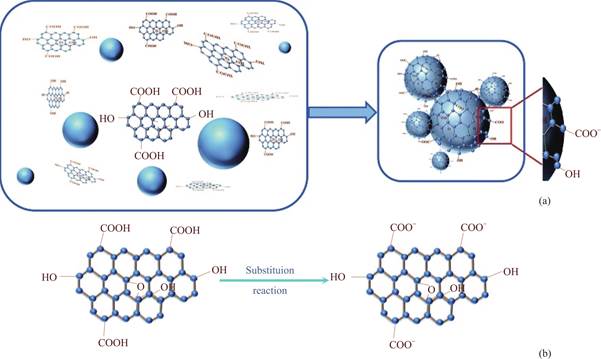
图3 (a)GO纳米片在水泥表面的吸附示意图;(b)GO在吸附过程中的取代反应[67]
Fig.3 (a)Schematic of GO nanosheets adsorption on the cement surface; (b)Substitution reaction of GO during the adsorption process[67]
化学方法在石墨烯的分散中起着重要作用,其中表面活性剂是最常见的改善石墨烯分散性的非共价官能化技术[52]。非共价官能化技术是利用氢键、离子键以及石墨烯与功能分子之间的静电力对材料进行改性,从而实现石墨烯在溶液中的稳定分散的方法[76-78]。常用的表面活性剂包括聚丙烯酸、苯磺酸钠和聚羧酸减水剂(Polycarboxylate Ether Superplasticizer,PCE)等[77]。在这些分散剂中,PCE因其对水泥水化过程几乎无副作用,且能够在碱性环境中有效分散石墨烯,而被推荐为最适合石墨烯的分散剂。Yan等[79]通过比较六种不同类型的表面活性剂(包括两种非离子表面活性剂和四种类型的聚羧酸减水剂),发现PCE在改善GO在Ca(OH)2溶液中的分散性方面表现最佳。如图4,聚羧酸分子具有梳状聚合物结构,其主链带有负电荷(丙烯酸/甲基丙烯酸),能够在颗粒之间产生空间排斥作用,从而保证石墨烯在水泥溶液中的稳定分散[80,81]。Sajjad等[82]的研究进一步验证了在水和石墨烯初步混合后,加入PCE并充分混合,能够帮助GO实现充分分散。
通常,单独利用物理分散技术或化学分散技术难以使石墨烯实现长期、稳定的分散,因此需要结合多种方法以实现更好的分散效果。例如,球磨工艺配合表面活性剂溶液的使用方式,可以实现更温和且有效的分散效果。Baig等[83]通过聚乙烯醇(Polyvinyl Alcohol,PVA)溶液和球磨工艺对不同掺量的GNP(0.5wt.%、1wt.%、1.5wt.%)进行了研究,结果显示这种组合不仅实现了良好的分散效果,而且减少了球磨时间,减少了对石墨烯结构的损伤。此外,超声技术与表面活性剂的结合也被证明是一种有效的分散方法。Fonseka等[84]利用PCE及超声技术对GO进行了分散处理,结果表明,与单掺PCE分散相比,复合分散技术处理的混凝土材料在28天龄期时拉伸强度、弯曲强度和弹性模量分别提高了24%、25%和30%,充分体现了显著的分散效果。进一步的研究证实,综合使用多种分散技术有利于石墨烯分散效率的提高。Wang等[85]实验发现,相较于干法球磨、湿法球磨、超声分散技术和直接分散技术,组合分散技术(湿法球磨、超声处理和PCE)处理后石墨烯溶液的浓度分别提高了61.8%、99.3%、74.0%、124.3%,实现了最高的分散效率,表明石墨烯得到了更好的分散。
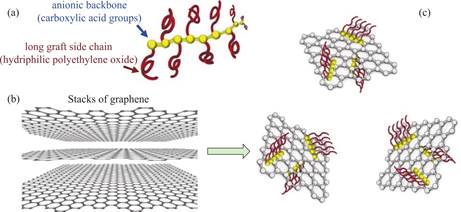
图4 (a)聚羧酸分子;(b)絮凝的石墨烯片;(c)均匀分散的石墨烯片的微观视图[86]
Fig.4 Microstructural views of(a)polycarboxylate molecule, (b)flocculation of graphene sheets,(c)homogeneous dispersed graphene[86]
2 石墨烯改性UHPC早期理化性能
2.1 水化性能
水泥水化反应是胶凝材料性能发挥的核心环节,其水化程度可以通过水化热(热释放速率和热释放量)等参数直接判断。研究表明,石墨烯对早期水泥水化起到显著的促进作用。Meng和Khayat等[87]研究发现,与空白组相比,0.3%掺量的GNP使UHPC在72h时的累积水化热量增加了45%,同时减少了UHPC的水化诱导期(-50%),表明胶凝材料(水泥、粉煤灰、硅灰)的水化程度显著增强。Meng等[88]进一步研究发现,石墨烯和GO可以极大地促进水泥浆中的离子迁移,尤其是Ca2+,从而促进离子簇的形成,并在水泥表面产生大量的针状C-S-H颗粒。Cui等[89]的研究发现MLG能够促进Ca2+和Al3+的水解及离子迁移,从而增强了水泥表面与离子之间的相互作用,并生成了更多的水化产物。
此外,石墨烯的大比表面积能够促进成核效应,从而定向诱导水化产物生成。Dong等[72]研究发现石墨烯的掺入可以通过诱导水化产物定向生长,形成三维互锁的C-S-H/石墨烯复合凝胶体系,有利于优化C-H生长空间,更好地发挥石墨烯的桥接作用。如图5所示,C-S-H凝胶沉淀在石墨烯表面随后不断生长。同时,当链状石墨烯聚合物结构发生折叠时,C-S-H凝胶会形成更致密的沉积物并向外生长形成突出的结构,一些CH晶体分散在C-S-H凝胶中,进而形成以石墨烯为中心的核壳单元。
进一步研究发现,石墨烯对UHPC内部孔结构和ITZ产生显著影响。Dong等[72]的研究还发现石墨烯起到了减小UHPC内部孔隙率及优化孔结构的作用,通过图6(a)~(d)所示,掺入不同横向尺寸(3μm、10μm和50μm)的石墨烯后UHPC孔隙率均降低,同时,比表面积、孔径分布曲线和总孔隙率均表明随着石墨烯横向尺寸的增大,掺有石墨烯的UHPC内部孔隙不断细化。Wang等[90]研究发现MLG可增加ITZ中的水化作用程度,减少了低密度(low density,HD)C-S-H比例,并增加了高密度(High density,HD)C-S-H和超高密度(Ultra high density,UHD)C-S-H的比例。Jiang等[91]同样验证了GO能够促进UHPC浆体中HD及UHD C-S-H凝胶的形成,使得GO改性UHPC的弹性模量提高了4.1%~12.9%。
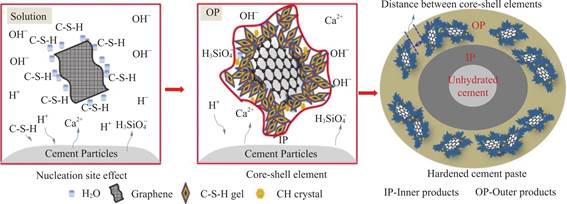
图5 石墨烯对水化产物结构的影响[72]
Fig.5 Effect of graphene on the microstructure of hydration product [72]
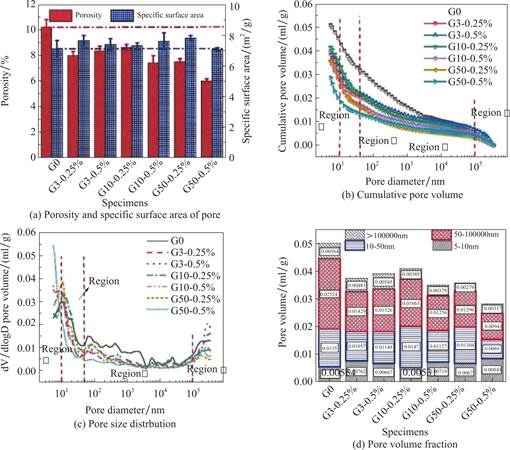
图6 UHPC与石墨烯的孔隙率和孔结构[72]
Fig.6 Porosity and pore structure of UHPC incorporating graphene[72]
2.2 流变性能
UHPC在新拌合状态下表现出复杂的流变特性,而石墨烯的掺入会对UHPC浆体的流变特性产生显著影响。研究人员通过多种流变测量方法(如同轴圆筒、叶片叶轮式流变仪[92,93])及分析模型(包括Bingham模型(τ=τ0+μp )、改良的Bingham(M-B)模型(τ=τ0+μp
 +c
+c ),以及Herschel-Bulkley(H-B)模型(τ=τ0+κ
 ))来评估UHPC浆体的流变性能,其中剪切屈服应力τ0和塑性黏度μp是衡量流变性能的重要参数[97-100]。
已有研究表明,石墨烯对水泥基浆体流变特性的影响具有双重性[20]。一方面,随着石墨烯掺量的增加,其较大的比表面积会吸附自由水分,同时石墨烯会形成絮凝结构并锁住水分,导致内摩擦阻力提升,进而浆体流动性降低[101]。例如,Wang等[102]发现,FG掺量的增加时,新拌合水泥浆体的屈服应力和塑性黏度显著增加,其中对屈服应力影响显著,与空白组相比,屈服应力增加了167.5%。另一方面,石墨烯的堆叠片层在剪切力作用下可能会发生层间滑移,起到润滑作用,同时释放絮凝结构内部锁住的水分,导致内摩擦阻力降低,进而浆体流动性提高。这种摩擦与润滑作用的竞争关系动态影响着浆体的流变参数。Li等[103]发现,MLG掺量从0.00wt.%增加到3.79wt.%时,水泥浆体的屈服应力在0.2~0.6Pa范围内波动。但当MLG掺量超过3.79wt.%时,屈服应力急剧增加。Hulagabali等[104]则观察到GO和rGO掺量为0.03%时水泥浆体的屈服应力最高,随着掺量增加,屈服应力开始下降。
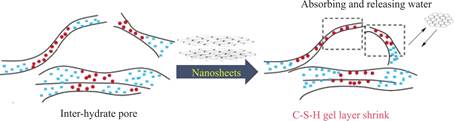
图7 石墨烯改性UHPC中C-S-H凝结结构变化示意图[20]
Fig.7 Schematicillustration of structural change in C-S-H gel within graphene-modified UHPC [20]
因此,石墨烯对UHPC新拌合浆体的流变性能产生显著影响,为实际工程应用提供了启发。Meng等[87]研究发现,当掺量超过0.15%,GNP改性UHPC浆体的屈服应力显著增大,而塑性黏度值始终小于对照组,认为GNP的添加增加了胶凝材料的堆积密度,释放了一定比例孔隙水,降低了UHPC浆体的黏度。Lamastra等[105]研究了超低掺量(0.01wt.%)的GNP或纳米石墨(Nano graphite,nG)复合UHPC浆体,发现超低掺量石墨烯可以起到填充效果,同时对其工作性能没有实质性影响,而黏度测量表明,高比表面积的nG容易形成絮凝结构,且当受剪切力作用时产生一定的润滑作用。Ismail等[106]研究发现GNP的附着会增强钢筋与周围混凝土之间的黏附力,从而减少钢筋的滑动倾斜度,因此,石墨烯的掺入,对UHPC内部纤维和混凝土之间的黏合强度也有提升效果。基于上述机理研究,可定向服务于特殊工程场景需要。例如,(1)水下修复工程[107,108]:需要维持高屈服应力 >15Pa)与塑性黏度(
 >0.3Pa·s)以抵抗水流冲刷;(2)喷射混凝土[93,109]:需要协调泵送阶段≈5Pa)与喷射阶段(
 ≈20Pa)的流变特性动态变化;(3)3D打印混凝土[110,111]:需要浆体兼具挤出流动性(<0.2Pa·s)并与纤维形成较好的结构稳定性(>10Pa)。
2.3 工作性能
UHPC的工作性能包括流动性、黏聚性、和保水性等,是确保施工顺利进行的关键,通常通过微坍落度、扩展度、流度测试来评估UHPC的工作性能。研究表明,石墨烯的掺入降低了新拌合UHPC浆体的工作性能。Regalla等[112]实验发现,随GO掺量从0.0%增加至0.1%,UHPC浆体微坍落度从230mm降低至180mm,证明石墨烯改性UHPC的流动性显著降低。Yeke和Yu等[113]同样发现,添加0.06wt.%的GO后,与空白组相比,UHPC浆体流动性减少了11.7%。Wu等[114]的研究也显示,掺入0.05wt.%的GO会导致UHPC新拌合浆体的微坍落度降低至270mm,这是由于GO的高比表面积吸附了部分水分,减少了拌合物中参与水化反应的自由水分,进而导致流动性降低。然而,Meng和Huang等[115]发现,少量GNP的掺入能够提高UHPC的堆积密度,从而释放基体孔隙中的水分,增加流动性,但随着GNP的掺量的增加,吸附效应重新占据主导地位,导致流动性下降。此外,Luo等[116]研究了GO和微钢纤维(Micro steel fiber,MSF)综合作用降低了新拌合UHPC浆体流动性,当GO掺量从0.0wt.%增加到0.03wt.%,0.5%掺量MSF下UHPC浆体的微坍落度从221mm降低到186mm,而1.0%掺量MSF下UHPC浆体的微坍落度从197mm降低到176mm。
3 石墨烯改性UHPC的力学性能
3.1 静态力学性能
石墨烯的掺入对UHPC的早期强度和凝结硬化后的力学性能展现出增强效果[113,117,118]。Cui等[89]研究发现掺入0.08wt.%的MLG后,石墨烯复合UHPC试件的1天弯曲强度和抗压强度分别提高了31.6%和9.5%,这种增强效应随着养护龄期的延长而持续累积。Liu等[119]的实验进一步验证,少量GO的掺入促进了C-S-H凝胶和钙矾石(AFt)的形成和生长,促进了超早期强度提高。Chen等[120]研究发现,添加0.06%的GO后,UHPC的自体收缩率从513.37με降低到231.8με,降幅达54.85%,同时抗压强度和拉伸强度分别提高了8.24%和28.39%。
进一步研究发现,石墨烯掺量和分散对UHPC力学性能有显著影响。Luo等[116]研究发现,当GO掺量从0.01%增加至0.03%时,UHPC的抗压强度的增幅由1.3%升至6.1%,同时UHPC的弯曲强度的增幅由33%升至65%。他们认为随GO掺量增加,ITZ中的微观结构更均匀,进而提高了UHPC的力学性能。然而,当石墨烯掺量过高时,容易发生团聚,堆叠的石墨烯与水泥界面存在的缺陷又会导致UHPC力学性能的降低。Mao等[121]研究验证,当GO掺量从0.01%增加至0.05%时,UHPC的弯曲强度的增幅由26.8%降至2.9%,仅在低掺量下对静态力学性能提升最大。
以往研究发现,石墨烯的成核效应诱导产生更多的水化产物,减少了ITZ的宽度,优化了孔隙率和孔隙结构,进而提高了石墨烯改性UHPC的基体密实度,同时促进了力学性能的提升[122]。Dong等[72]研究发现,平均横向尺寸最大(为10μm)的石墨烯成核效应更明显,随着石墨烯掺量的增加,对石墨烯改性UHPC的三点弯曲强度的增强效果最显著,分别增加24.7%和30.0%。Li等[47]实验测得,掺入0.5wt.%的MLGs后,UHPC表现出的最大抗压强度最大,具体为123.2MPa。掺入0.75wt.%的MLGs后,UHPC的最大弯曲强度为11.08MPa,极限弯曲应变提高了18.7%,利用电阻率和电化学阻抗谱、扫描电镜以及能量色散光谱仪表征发现,随着MLGs的掺入,降低了C-S-H凝胶的钙硅比以及减小了CH晶体的尺寸,这意味着MLGs可以有效地填充UHPC基体中的孔隙并减少界面的薄弱区域。Gao等[123]实验发现,与空白组相比,GO改性UHPC的孔隙率降低了37.5%,抗压强度和弯曲强度分别提高了33.7%和26.2%。分子动力学模拟结果进一步表明,受益于GO在钢纤维表面的富集和裂缝桥接效应,钢纤维与UHPC基体之间的ITZ发生延性破坏。Wang等[124]同样研究发现,二维石墨烯等纳米填料使纤维增强聚合物(Fiber reinforced polymer,FRP)与混凝土之间的极限粘合强度分别提高了16.2%和37.8%,而发生的层间滑移分别降低了28.7%和35.4%。这种改性效果归因于石墨烯富集在FRP表面并通过纳米成核效应,优化了相邻界面中水化产物的组成,降低了孔隙率。
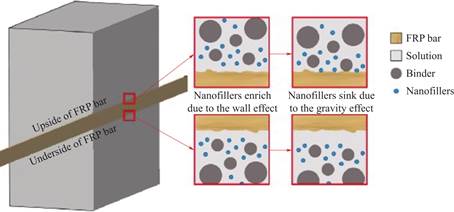
图8 纳米材料在纤维增强聚合物筋与UHPC界面的富集效应[124]
Fig.8 Enrichment effect of nanomaterial at the interface between FRP bar and UHPC [124]
3.2 动态力学性能
冲击荷载和疲劳破坏对建筑节点及结构会产生严重损害,对高层结构、桥梁、高铁轨道板以及跑道等基础设施,动态力学性能至关重要。石墨烯与混凝土具有良好的相容性和优异的化学稳定性,不仅可以保证纳米颗粒的成核效果,而且由于石墨烯的密度低、尺寸小,石墨烯掺入能在UHPC中能够形成较宽的空间网络分布[125],进而形成了更致密的微观结构,提高UHPC的抗冲击性能[125]。Wang等[126]的实验结果表明,在高应变率动态载荷(200~800s-1)下,石墨烯改性UHPC的动态抗压强度和冲击韧性分别提高了63.9%和117%。他们认为,在受到冲击荷载时,石墨烯还能够通过层间滑移与结构断裂的形式吸收冲击能。以往研究表明,石墨烯的掺入,可以增强纤维与UHPC基体之间的耦合作用[127,128]。考虑到掺入石墨烯的UHPC内部C-S-H凝胶比例增加,纤维与UHPC基体之间ITZ具有表现出更致密的微观结构,从而提高了UHPC动态冲击荷载下的力学性能[123,129]。Kuo等[130]实验发现,在28天龄期时,MLG改性UHPC可承受的最大冲击能量最大到325J,相较于普通UHPC提高了116.7%。
此外,石墨烯的增韧效应可以有效提高UHPC的抗疲劳性能。Li等[131]研究发现,在UHPC中掺入0.075wt.%的MLG后,UHPC的疲劳寿命、能量吸收和损伤指数分别提高了49.3%、333.1%和22.23%。石墨烯提升了UHPC的抗循环荷载能力。Foray-Thevenin理论模型[132]进一步阐明,石墨烯改性UHPC的破坏模式由脆性断裂向准塑性破坏转变。
4 石墨烯改性UHPC的耐久性能
4.1 抗渗透/侵蚀性能
耐久性能是指建筑结构抵抗各种破坏性因素,同时长期保持强度和外观完整性的能力。建筑结构在日常使用中会受水分渗透影响,当在严峻复杂环境中,还容易受到C 、S
、S 、Cl-等腐蚀性离子的侵蚀损害,危害着其耐久性能,随着人们研究,如表1,证明石墨烯的掺入对UHPC的耐久性能具有改善效果。Wang等[133]研究表明,石墨烯等纳米填料能有效改善超高性能水泥基材料(UHPCC)的内部微观结构,同样得益于石墨烯对UHPC内部孔结构的改善以及对微裂缝的桥接作用,进而提升了UHPC的耐久性能。Esmaeili等[134]在UHPC掺入工业氧化石墨烯(IGO),发现在0.04%和0.06%掺量下,UHPC的吸水率分别降低了11.10%和14.02%,一定程度抵抗了水等流体在UHPC基体中吸收渗透,其机理在于石墨烯诱导生成更多C-S-H凝胶,使基体结构更加致密,从而明显延缓了侵蚀过程。Chu等[135]的研究表明,掺入0.05wt.%的GO可使UHPC氯离子扩散系数下降12.07%。其机理在于GO可以减少毛细管通道中氯离子传输量,并起到了改善孔隙结构和体积稳定性的作用。研究人员还可以利用石墨烯表面涂层和掺入协同的方式强化UHPC的抗侵蚀能力。Qureshi等[136]研究发现,利用单层石墨烯(FLG)涂层使UHPC表面疏水角达152°,水分渗透率下降89%,同时内部掺入0.02wt.%的GO则通过细化毛细孔(<10nm,孔占比提升至78 %)实现了双重防护。
4.2 抗冻融循环性能
在寒冷地区,冻融循环作用是导致UHPC性能劣化的重要因素,抗冻融循环能力同时也是UHPC耐久性能的衡量指标之一。石墨烯可以提高UHPC的抗冻融性。Chu等[135]研究发现,300次冻融试验循环后,掺有0.0wt.%、0.25wt.%、0.50wt.%和0.75wt.%的GO改性UHPC质量损失率分别为0.79%、0.67%、0.44%和0.55%,表明GO对UHPC的质量损失率有一定程度改善。以往研究表明[137],石墨烯的掺入可以改善孔隙率,阻碍内部水分传输,并通过桥接作用起到抑制初始冻结裂缝的作用,进而提高UHPC的抗冻融循环能力。此外,石墨烯的掺入对UHPC内部孔隙冰点温度的降低有显著影响。Shah等[138]试验证实,掺入0.1wt.%的GNP的UHPC经150次冻融循环后质量损失率仅0.8%(对照组3.2%),分子动力学模拟表明,1~3nm石墨烯夹层内水的结晶温度降至-45℃,归因于石墨烯的纳米效应缩小了孔径尺寸,降低了孔隙冰点,显著抑制了冻胀压力。
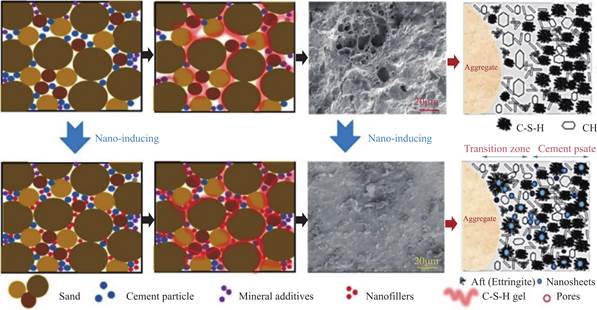
图9 纳米填料改性UHPCC孔结构变化示意图[133]
Fig.9 Schematic of pore structure modification in UHPCC using nanofillers [133]
表1 石墨烯改性UHPC的耐久性
Table 1 Durability performance of graphene-modified UHPC
|
石墨烯掺量(wt.%)
|
水胶比
|
耐久性
|
机理
|
参考文献
|
|
0/0.04/0.06/0.08/0.1
|
0.20
|
IGO掺量在0.06%时,其28天和90天龄期的吸水率均显著降低。
|
IGO促进C-S-H凝胶的生成以及减少了UHPC内部微孔隙
|
[134]
|
|
0.025/0.05/0.075
|
0.18
|
GO使孔隙率降低11.34%、氯离子渗透率下降12.07%
|
GO能够优化UHPC的孔隙结构
|
[135]
|
|
0.01
|
0.50
|
GNP使得孔隙率降低(-31%)、体积密度提高(+5.7%)、孔隙细化(中位和平均孔径分别为-35%和-9%)、电阻率增加(+97%)
|
超低掺量GNP即可对UHPC内部微观结构产生显著细化效果
|
[105]
|
|
—
|
0.2
|
GO提高了钢纤维表面粗糙度和亲水性,增强了ITZ界面的连接,同时促进水化使UHPC孔隙率降低了37.5%
|
GO可以在UHPC的水化过程中提供孔隙填充和成核效果
|
[123]
|
|
0.03
|
0.17
|
GO使得磨损损失率降低了10.01%,极限冲击能提高了1.76%,韧性指数提高了10.10%
|
GO与硅铝酸钙水合物(C-A-S-H)之间形成稳定的化学键,提高了C-A-S-H的耐磨性
|
[139]
|
5 石墨烯改性UHPC多功能特性
5.1 电学性能
UHPC基体的低导电性限制了其在智能基础设施中的应用,而掺入石墨烯可以在UHPC基体中建立导电网络,显著改善UHPC基体的电学性能[140]。Princigallo[141]实验发现,随着石墨烯掺量的增加,UHPC基体电阻率降低,然而石墨烯改性UHPC的体系更加复杂,在石墨烯掺量范围在(≤1wt.%)时未对UHPC表面电阻率有大改善。以往研究人员发现,在水泥基材料中,导电网络的建立遵循渗流阈值理论,具体而言,当石墨烯掺量较低时,石墨烯孤立分布,仅靠离子导电发挥作用;随着掺量继续增大达到渗流阈值时,石墨烯通过接触导电与量子隧穿效应构建导电网络[142],但随石墨烯掺量继续增加,引发的团聚不利于导电网络的建立。Chen[143]研究发现,随着石墨烯掺量的增加,UHPC的体积电阻率降低,但石墨烯掺量超过0.3%后,UHPC的体积电阻率逐渐稳定。Guo等[144]实验发现在UHPC中GNP掺量从0%、0.01%、0.05%、增加到0.1%时,UHPC的电阻率先从18.85kΩ·m降低到6.26kΩ·m,随后在0.1%掺量下增高。此外,有研究人员提出,石墨烯的均匀分散更有利于改善内部导电路径并降低整体电阻率。Rayed等[145]实验发现GNP改性UHPC在0.1%掺量时电阻率下降最大(-14%),并认为分散良好的GNP,一方面会会产生桥接效应,减少或转移裂纹开展路径,这导致了致密的微观结构,从而改善了导电路径并降低了电阻率;另一方面,均匀分散的GNP可以建立更多导电路径,进而降低UHPC的电阻率。
5.2 自感知性能
石墨烯的掺入改善了UHPC的导电性能和感知特性,使其能够通过电阻率的变化监测内部力和外部荷载引起的变形情况,从而使UHPC具备自感知性能,方便用来评估结构的健康和安全性,减少和避免潜在危害的发生[41,146-148]。电阻率分数变化(Fraction Change in Resistivity,FCR)和应变系数(Gauge Factor,GF)通常用于评估石墨烯增强水泥基复合材料的感知特性和应变灵敏度[147,149]。Sun等[150]研究表明,石墨烯增强水泥基复合材料在不同载荷速率下呈现灵敏的FCR响应,使其在建筑中可以作为应变/损伤传感器使用。Song等[151]研究表明,掺有少层石墨烯(Few layer graphene,FLGs)不仅提升了UHPC的导电性能,还增强了其感知稳定性。随着FLGs掺量从0.25wt.%增加至1.00wt.%,最小FCR值相对于空白组分别增加了80.79%、69.54%、127.15%、58.28%。当石墨烯掺量为0.75wt.%时,在40MPa的循环荷载下可以获得稳定的FCR响应,同时表现出更加明显且噪声更小的压敏特性(1.00wt.%掺量FLGs改性UHPC的GF值为48,远高于传统的应变传感器的GF值(约为2))。Guo等[144]研究发现掺入0.05%的GNPs后,UHPC的FCR值约为20%,几乎是不掺GNPs的UHPC的两倍,同时在循环载荷下GNP改性UHPC的FCR值与压应力呈线性关系,表现出优异的压敏特性,进一步验证了石墨烯对UHPC自感知性能的提升作用。
5.3 导热性能
大体积UHPC在浇筑过程中,由于水泥水化释放大量热量,UHPC内部温度梯度升高会导致热应力集中,从而增加开裂的风险。此外,当遭遇火灾或暴露在高温环境时,UHPC结构孔隙内压力、裂缝开展和外层剥落严重危害着UHPC结构的稳定性,有必要采取措施来提高UHPC的导热性能[152]。目前关于石墨烯改性UHPC导热性能的研究较少,以往研究表明[153],石墨烯因其非凡的导热性(~ 5300 W/mK)可以提升石墨烯改性混凝土材料的导热性能。Li等[131]研究发现,MLG降低了混凝土复合材料内部的温差和热应力,如图11所示,在浇筑成型后的48小时内,MLG的掺入使其他位置的温度更接近内部位置的温度,0.25wt.%和0.5wt.%的最大温差仅为0.1℃和0.2℃,而空白组的最大温差上升到0.8℃。这种现象可能是由于以下原因:均匀分散的石墨烯能形成三维导热网络,通过提高整体导热系数、改善导热路径、填充孔隙的机制提升建筑结构在高温环境下的稳定性[154]。Win等[155]研究发现,掺入1.2wt.%的石墨烯,在不影响
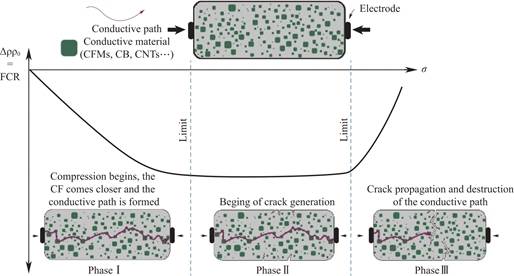
图10 自感应结构的变化机制[147,149]。第一阶段:随着受压荷载的增加,FCR降低;
第二阶段:裂缝形成;第三阶段:裂缝扩展,传导路径中断
Fig.10 Mechanism of evolution in self-sensing structures[147,149].Phase I:Decreases with increasing compressive load;Phase II:Crack initiation;Phase III:Disruption of conductive pathways due to crack propagation
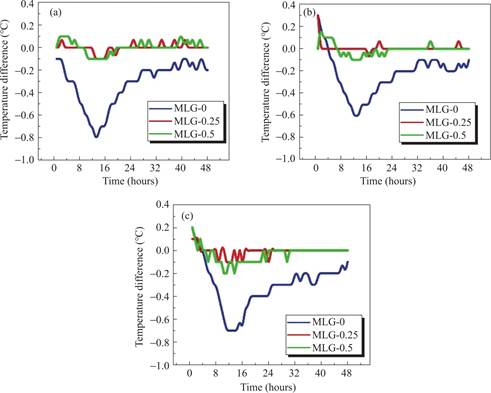
图11 浇筑成型48 h后MLG增强UHPC试件(a)内部和外部上部位置;
(b)内部和中间位置;(c)内部和外部角落位置之间的温差曲线[131]
Fig.11 Temperature difference curves in MLG reinforced UHPC specimens 48 hours after casting: (a)inner and upper outer positions;(b)inner and middle positions;(c)inner and corner positions [131]
UHPC抗压强度的情况下,UHPC的导热系数提高了约69%。此外,Rao等[156]的研究表明石墨烯的桥接效应和片层滑移的协同,一定程度提高了混凝土材料受高温热应力下的韧性。因此,可以认为石墨烯的掺入可以改善UHPC的导热性能和热稳定性。
5.4 智能特性
建筑材料智能化是未来建筑领域的重要研究方向,得益于石墨烯改性UHPC表现出的优异电学性能、自感知性能、导热性能,其在混凝土自加热[149,157]、结构健康监测[158-160]、能量的收集与转化[161,162]和电磁屏蔽[150,163]等领域展现出广阔的应用前景(图12),从而显著提升建筑结构的舒适性、安全性、耐久性和可持续性[164,165]。
在自加热方面,石墨烯改性UHPC通过施加特定电压,在结构低电阻部分产生焦耳热,并通过石墨烯和金属纤维建立的三维网络进行热传导,将热量从高温区域传递至低温区域,起到了融雪除冰、低温养护、住宅保暖的作用。Wang等[166]的研究表明,掺入1.5wt.%多层石墨烯(MLG)的UHPC电阻率为3.2Ω·cm,在施加72 V电压后,2小时内可融化1cm厚的积雪,3小时内可融化3cm厚的积雪。Zheng等[167]则发现,掺入GNP的高强度混凝土(HSC)在-20℃下表现出优异的电热(ET)固化性能,有效提升了GNP复合HSC的早期强度。
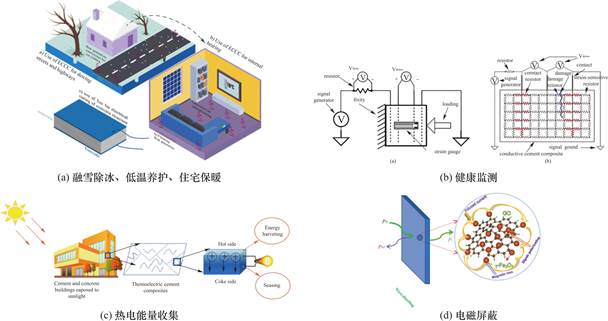
图12 石墨烯改性UHPC智能化应用
Fig.12 Smart applications of graphene-modified ultra-high-performance concrete
在结构健康监测方面,石墨烯复合UHPC可作为应力-应变/氯离子传感器。Downey等[168]建立并验证了一种电阻网格模型,用于识别、定位和量化结构中的裂缝。因此,结合电阻网格模型,石墨烯改性UHPC能通过电阻率的变化实时反映结构损伤及氯离子渗透情况。
在热电能量收集转化领域,热电转换的工作原理基于塞贝克效应(Seebeck effect)、佩尔捷效应(Peltier effect)和汤姆逊效应(Thomson effect),当材料内部载流子随温度变化移动时,可产生电势差并伴随吸热或放热现象,从而实现能量的收集与转化[169,170]。石墨烯的导电性和对温度梯度的响应使其成为理想的热电材料,Singh[162]和Ghosh等[171]表明,钢纤维和GNP的掺入对水泥基复合材料的热电性能有较好的增强效果,石墨烯改性UHPC的电学性能显著提升,使其也可作为热电材料,有望为能源转化利用及改善建筑能耗做出有价值的贡献。
在电磁屏蔽方面,石墨烯改性UHPC表现出优异的电磁波吸收性能。Sun等[150]的研究表明,掺入10vol%石墨烯的水泥浆体在电磁干扰屏蔽效果和反射率方面分别达到10.4dB和33dB,分别是空白组的1.6倍和7倍。Kuo等人[130]表明,掺入MLG和碳纤维的UHPC的电磁屏蔽能力显著提升,其中,MLG的掺入对低频电磁干扰表现出更强的电磁屏蔽能力。Song等[163]则发现,掺入氧化石墨烯(GO)和磁性氧化铁的UHPC板材在18GHz频段的反射率达到-21.13dB,可吸收99%以上的电磁波,主要得益于GO的界面极化和磁性氧化铁的磁损耗效应。
6 结论
石墨烯已被证实可以从纳米尺度到宏观尺度对UHPC性能产生显著影响,对UHPC的电学性能、力学性能、耐久性以及多功能/智能性起到了良好的改性效果,有望实现石墨烯改性UHPC结构-功能一体化的目标。具体而言,石墨烯的掺入能够:(1)优化微观结构:通过促进水泥水化反应,石墨烯能够细化水化产物,优化ITZ和孔隙结构,从而提升基体的致密性和均匀性;(2)改善力学性能:研究表明,石墨烯的掺入显著提高了UHPC的抗压强度、抗弯强度和抗冲击性能;(3)提升耐久性:石墨烯改性UHPC优化的微观结构,增强了UHPC的抗渗透性和抗冻融性;(4)赋予多功能特性:石墨烯改善了UHPC的导电性能和压敏特性,进而使UHPC具备自感知能力,可用于结构健康监测。此外,石墨烯改性UHPC还展现出优异的导热性能和电磁屏蔽能力,为其在智能建筑和能源领域应用提供了可能。
7 面临的挑战和发展策略
石墨烯对UHPC的改性机理,一方面,依靠石墨烯自身优异的各项特性,另一方面,在UHPC内能促进水泥水化,优化C-S-H凝胶结构,提升基体致密性,具有较好的填充作用,改善UHPC内部界面过渡区和孔隙结构,构建三维导电/导热网络以及延缓裂缝开展的作用。然而,现有研究多基于传统水泥基复合材料体系进行机理解释,未能充分揭示UHPC多组分协同作用下的特殊规律。在UHPC体系中,石墨烯的掺入会受内部多种胶凝材料以及纤维的综合影响,例如,其流变行为对石墨烯的分散效果、水泥水化程度、内部孔隙分布、纤维取向及分布等具有重要影响,进而关系凝结硬化后UHPC的各项性能好坏。因此,需要更为系统和科学的研究路径,来揭示不同组成成分对微观结构耦合作用与宏观性能的关联性,未来有望借助离散元模拟和机器学习等方式,深入分析石墨烯-纤维-胶凝基体界面行为的关联机制,定性定量研究石墨烯对UHPC的综合影响。此外,如何分散石墨烯是另一个主要挑战,石墨烯的掺量和分散效果对UHPC的影响显著,随石墨烯掺量增加积极改善UHPC各项性能的同时,作为一种大比表面积材料,石墨烯易发生团聚,UHPC又会受到石墨烯团聚体造成的消极影响。目前已有研究通过新的思路来实现石墨烯的分散,一方面,增加对于分散效率的先验环节有助于对各种分散工艺的理解与优化;另一方面,调整分散思路,结合表面涂层以及内部掺入的方法,也可以更好的发挥石墨烯改善作用。
此外,石墨烯改性UHPC的规模化应用需平衡技术经济性与环境可持续性。据石墨烯产研报告表明,传统制备的石墨烯产品成本(100~500美元/g)及碳排放强度(50~80kg CO2/kg)较高。通过闪蒸焦耳法制备FG将废碳源转化,将石墨烯成本降至10~20美元/g,碳排放强度锐减至5~10kg CO2/kg,结合生物质衍生技术(如椰壳炭),可进一步减少70%化石原料依赖,形成农业废弃物资源化利用模式。尽管初始材料成本较高,石墨烯改性UHPC展现出显著的全生命周期优势,理论服役寿命延长至100~150年(传统UHPC约50~80年),全生命周期维护成本大幅降低,同时可凭借其导电/自感知特性支持结构健康监测系统原位集成而减少运维支出。此外,材料性能提升可减少水泥用量,以及对工业副产品(如硅灰)的高效利用可间接降低碳足迹,减少生态负荷。最后,目前对于石墨烯改性UHPC的研究通常局限在实验室研究,急需促进工程应用以对其进行检验,还需要大力研究效果可控、成本优化的方案,为石墨烯在大规模及复杂环境下的材料应用提供新的可能。
综上所述,石墨烯改性UHPC具有安全耐用、多功能特性、低碳可持续的优势,具有广阔的应用前景和研究价值。随着科技不断进步,石墨烯改性UHPC有望作为一种新型可持续的建筑工程材料,从而引发基础设施的变革。
利益冲突: 作者声明无利益冲突。
[①] *通讯作者 Corresponding author:王欣悦,xinyuewang@tju.edu.cn;韩宝国,hanbaoguo@dlut.edu.cn
收稿日期:2025-03-17; 录用日期:2025-03-25; 发表日期:2025-06-28
基金项目:本项研究得到了国家自然科学基金项目(资助号:52308236,52368031,52178188)、全国建材行业重大科技攻关“揭榜挂帅”项目(资助号:2023JBGS10-02)、辽宁省自然联合基金(资助号:2023-BSBA-077)和中央高校基本科研业务费(资助号:DUT24GJ202)的资助。
参考文献(References)
[1] Meyer C. The greening of the concrete industry[J]. Cement and concrete composites, 2009, 31(8): 601-605.
https://doi.org/I:10.1016/j.cemconcomp.2008.12.010.
[2] Huang H, Ren X, Liu Z, et al. Development of low-carbon and cost-effective ultra-high performance concrete using carbonated recycled fine aggregate[J]. Construction and Building Materials, 2023, 399: 132575.
https://doi.org/10.1016/j.conbuildmat.2023.132575.
[3] Krystek M, Ciesielski A, Samorì P. Graphene-based cementitious composites: toward next-generation construction technologies[J]. Advanced Functional Materials, 2021, 31(27): 2101887.
https://doi.org/10.1002/adfm.202101887.
[4] de Brito J, Kurda R. The past and future of sustainable concrete: A critical review and new strategies on cementbased materials[J]. Journal of Cleaner Production, 2021, 281: 123558.
https://doi.org/10.1016/j.jclepro.2020.123558.
[5] Barbhuiya S, Kanavaris F, Das B B, et al. Decarbonising cement and concrete production: Strategies, challenges and pathways for sustainable development[J]. Journal of Building Engineering, 2024: 108861.
https://doi.org/10.1016/j.jobe.2024.108861.
[6] Shi C, Wu Z, Xiao J, et al. A review on ultra high performance concrete: Part I. Raw materials and mixture design[J]. Construction and Building Materials, 2015, 101: 741-751.
https://doi.org/10.1016/j.conbuildmat.2015.10.088.
[7] Du J, Meng W, Khayat K H, et al. New development of ultra-high-performance concrete(UHPC)[J]. Composites Part B: Engineering, 2021, 224: 109220.
https://doi.org/10.1016/j.compositesb.2021.109220.
[8] Wang S, Wang B, Zhu H, et al. Ultra-high performance concrete: Mix design, raw materials and curing regimes- A review[J]. Materials Today Communications, 2023, 35: 105468.
https://doi.org/10.1016/j.mtcomm.2023.105468.
[9] Sharma R, Jang J G, Bansal P P. A comprehensive review on effects of mineral admixtures and fibers on engineering properties of ultra-high-performance concrete[J]. Journal of Building Engineering, 2022, 45: 103314.
https://doi.org/10.1016/j.jobe.2021.103314.
[10] Zhou Z, Xie R, Qiao P, et al. On the modeling of tensile behavior of ultra-high performance fiber-reinforced concrete with freezing-thawing actions[J]. Composites Part B: Engineering, 2019, 174: 106983.
https://doi.org/10.1016/j.compositesb.2019.106983.
[11] Yoo D Y, Shin H O, Lee J Y, et al. Enhancing cracking resistance of ultra-high-performance concrete slabs using steel fibres[J]. Magazine of Concrete Research, 2015, 67(10): 487-495.
https://doi.org/10.1680/macr.14.00116.
[12] Pyo S, Alkaysi M, El-Tawil S. Crack propagation speed in ultra high performance concrete(UHPC)[J]. Construction and Building Materials, 2016, 114: 109-118.
https://doi.org/10.1016/j.conbuildmat.2016.03.148.
[13] Khodabandeh P, Azarhomayun F, Shekarchi M, et al. Experimental investigation of using Ultra-High-Performance Concrete coating for anti-corrosion protection of reinforced concrete induced by chloride ions[J]. Journal of Building Engineering, 2024, 97: 110743.
https://doi.org/10.1016/j.jobe.2024.110743.
[14] Akhnoukh A K, Buckhalter C. Ultra-high-performance concrete: Constituents, mechanical properties, applications and current challenges[J]. Case Studies in Construction Materials, 2021, 15: e00559.
https://doi.org/10.1016/j.cscm.2021.e00559.
[15] Azmee N M, Shafiq N. Ultra-high performance concrete: From fundamental to applications[J]. Case Studies in Construction Materials, 2018, 9: e00197.
https://doi.org/10.1016/j.cscm.2018.e00197.
[16] Xue J, Briseghella B, Huang F, et al. Review of ultrahigh performance concrete and its application in bridge engineering[J]. Construction and Building Materials, 2020, 260: 119844.
https://doi.org/10.1016/j.conbuildmat.2020.119844.
[17] Bae Y, Pyo S. Effect of steel fiber content on structural and electrical properties of ultra high performance concrete( UHPC)sleepers[J]. Engineering Structures, 2020, 222: 111131.
https://doi.org/10.1016/j.engstruct.2020.111131.
[18] Fan J, Shao Y, Bandelt M J, et al. Sustainable reinforced concrete design: The role of ultra-high performance concrete(UHPC)in life-cycle structural performance and environmental impacts[J]. Engineering Structures, 2024, 316: 118585.
https://doi.org/10.1016/j.engstruct.2024.118585.
[19] Ding S, Wang X, Han B. New-generation cement-based nanocomposites[M]. Springer Singapore, 2023.
https://
doi:10.1007/978-981-99-2306-9
[20] Wang J, Dong S, Zhou C, et al. Investigating pore structure of nano-engineered concrete with low-field nuclear magnetic resonance[J]. Journal of Materials Science, 2021, 56: 243-259.
https://doi.org/10.1007/s10853-020-05268-0.
[21] Yoo D Y, Oh T, Banthia N. Nanomaterials in ultrahigh- performance concrete(UHPC)-A review[J]. Cement and Concrete Composites, 2022, 134: 104730.
https://doi.org/10.1016/j.cemconcomp.2022.104730.
[22] Janavika K M, Thangaraj R P. Graphene and its application: A review[J]. Materials Today: Proceedings, 2023.
https://doi.org/10.1016/j.matpr.2023.05.446.
[23] Alateah A H. Graphene concrete: Recent advances in production methods, performance properties, environmental impact and economic viability[J]. Case Studies in Construction Materials, 2023, 19: e02653.
https://doi.org/10.1016/j.cscm.2023.e02653.
[24] Radman A, Joorabchi N. Property assessment of concretes with graphene oxide mixed cement[C]//IOP Conference Series: Materials Science and Engineering. IOP Publishing, 2019, 652(1): 012043.
https://doi.org/10.1088/1757-899X/652/1/012043.
[25] Tong T, Fan Z, Liu Q, et al. Investigation of the effects of graphene and graphene oxide nanoplatelets on themicro-and macro-properties of cementitious materials[J]. Construction and Building Materials, 2016, 106: 102-114.
https://doi.org/v10.1016/j.conbuildmat.2015.12.092.
[26] Han B, Ding S, Wang J, et al. Graphene-Engineered CementitiousComposites[M]. Springer Singapore, 2019.
https://doi.org/10.1007/978-981-13-7078-6.
[27] Chen G, Yang M, Xu L, et al. Graphene NanoplateletsImpact on Concrete in improving freeze-thaw resistance[J]. Applied Sciences, 2019, 9(17): 3582.
https://doi.org/10.3390/app9173582.
[28] Shah H A, Yuan Q, Photwichai N. Use of materials tolower the cost of ultra-high-performance concrete-A review[J]. Construction and Building Materials, 2022, 327: 127045.
https://doi.org/10.1016/j.conbuildmat.2022.127045
[29] Lv S, Ma Y, Qiu C, et al. Effect of graphene oxidenanosheets of microstructure and mechanical propertiesof cement composites[J]. Construction and buildingmaterials, 2013, 49: 121-127.
https://doi.org/v10.1016/j.conbuildmat.2013.08.022.
[30] Shamsaei E, de Souza F B, Yao X, et al. Graphene-basednanosheets for stronger and more durable concrete: Areview[J]. Construction and Building Materials, 2018, 183: 642-660.
https://doi.org/10.1016/j.conbuildmat.2018.06.201.
[31] Wang R, Sun R, Zhao L, et al. Investigation of the dispersionof reduced graphene oxide in cementitious compositesunder different mixing strategies[J]. Journal ofBuilding Engineering, 2023, 77: 107447.
https://doi.org/10.1016/j.jobe.2023.107447.
[32] Liu C, He X, Deng X, et al. Application of nanomaterialsin ultra-high performance concrete: A review[J]. Nanotechnology Reviews, 2020, 9(1): 1427-1444.
https://doi.org/10.1515/ntrev-2020-0107.
[33] Liu Y, Zhong X, Mohammadian H R. Role carbon nanomaterialsin reinforcement of concrete and cement; Anew perspective in civil engineering[J]. Alexandria EngineeringJournal, 2023, 72: 649-656.
https://doi.org/10.1016/j.aej.2023.04.025.
[34] Han B, Zheng Q, Sun S, et al. Enhancing mechanisms ofmulti-layer graphenes to cementitious composites[J]. Composites Part A: Applied Science and Manufacturing, 2017, 101: 143-150.
https://doi.org/10.1016/j.compositesa.2017.06.016.
[35] Li L, Wang B, Hubler M H. Carbon nanofibers(CNFs)dispersed in ultra-high performance concrete(UHPC): Mechanical property, workability and permeability investigation[J]. Cement and Concrete Composites, 2022, 131: 104592.
https://doi.org/10.1016/j.cemconcomp.2022.104592.
[36] Li S, Zhang Y, Cheng C, et al. Surface-treated carbonnanotubes in cement composites: Dispersion, mechanicalproperties and microstructure[J]. Construction andBuilding Materials, 2021, 310: 125262.
https://doi.org/10.1016/j.conbuildmat.2021.125262.
[37] Wu Z, Khayat K H, Shi C. Effect of nano-SiO2 particlesand curing time on development of fiber-matrix bondproperties and microstructure of ultra-high strength concrete[J]. Cement and Concrete Research, 2017, 95: 247-256.
https://doi.org/10.1016/j.cemconres.2017.02.031.
[38] Du J, Guo P, Meng W. Effect of water-based nanoclayand ambient temperature on rheological properties ofUHPC pastes[J]. Construction and Building Materials, 2023, 370: 130733.
https://doi.org/10.1016/j.conbuildmat.2023.130733.
[39] Guo Y, Wang D, Ashour A, et al. Self-sensing ultrahighperformance concrete: a review[J]. MeasurementScience and Technology, 2023, 35(3): 032003.
https://doi.org/10.1088/1361-6501/ad092d.
[40] Li J, Wu Z, Shi C, et al. Durability of ultra-high performanceconcrete-A review [J]. Construction andBuilding Materials, 2020, 255: 119296.
https://doi.org/10.1016/j.conbuildmat.2020.119296.
[41] Han J, Pan J, Cai J, et al. A review on carbon-basedself-sensing cementitious composites[J]. Constructionand Building Materials, 2020, 265: 120764.
https://doi.org/10.1016/j.conbuildmat.2020.120764.
[42] Mbayachi V B, Ndayiragije E, Sammani T, et al. Graphenesynthesis, characterization and its applications: Areview[J]. Results in Chemistry, 2021, 3: 100163.
https://doi.org/10.1016/j.rechem.2021.100163.
[43] Balandin A A, Ghosh S, Bao W, et al. Superior thermalconductivity of single-layer graphene[J]. Nano letters, 2008, 8(3): 902-907.
https://doi.org/10.1021/nl0731872.
[44] Bolotin K I, Sikes K J, Jiang Z, et al. Ultrahigh electronmobility in suspended graphene[J]. Solid state communications, 2008, 146(9-10): 351-355.
https://doi.org/10.1016/j.ssc.2008.02.024.
[45] Stoller M D, Park S, Zhu Y, et al. Graphene-based ultracapacitors[J]. Nano letters, 2008, 8(10): 3498-3502.
https://doi.org/10.1021/nl802558y.
[46] Geim A K. Graphene: Status and Prospects[J]. Science, 2009, 324(5934): 1530-1534.
https://doi.org/10.1126/science.1158877.
[47] Li L, Zheng Q, Dong S, et al. The reinforcing effectsand mechanisms of multi-layer graphenes on mechanicalproperties of reactive powder concrete[J]. Constructionand Building Materials, 2020, 251: 118995.
https://doi.org/10.1016/j.conbuildmat.2020.118995.
[48] Devi S C, Khan R A. Effect of graphene oxide on mechanicaland durability performance of concrete[J]. Journal of Building Engineering, 2020, 27: 101007.
https://doi.org/10.1016/j.jobe.2019.101007.
[49] Qi G, Wang Q, Zhang R, et al. Effect of rGO/GNP onthe electrical conductivity and piezoresistance of cement-based composite subjected to dynamic loading[J]. Construction and Building Materials, 2023, 368: 130340.
https://doi.org/10.1016/j.conbuildmat.2023.130340.
[50] Souza F B D, Yao X, Lin J, et al. Effective strategies torealize high-performance graphene-reinforced cementcomposites[J]. Construction and Building Materials, 2022, 324: 126636.
https://doi.org/10.1016/j.conbuildmat.2022.126636.
[51] Hummers Jr W S, Offeman R E. Preparation of graphiticoxide[J]. Journal of the american chemical society, 1958, 80(6): 1339-1339.
https://doi.org/10.1021/ja01539a017.
[52] Yu W, Sisi L, Haiyan Y, et al. Progress in the functionalmodification of graphene/graphene oxide: A review[J]. RSC advances, 2020, 10(26): 15328-15345.
https://doi.org/10.1039/D0RA01068E.
[53] Saafi M, Tang L, Fung J, et al. Enhanced properties ofgraphene/fly ash geopolymeric composite cement[J]. Cement and Concrete Research, 2015, 67: 292-299.
https://doi.org/10.1016/j.cemconres.2014.08.011.
[54] Gholampour A, Valizadeh Kiamahalleh M, Tran D NH, et al. From graphene oxide to reduced graphene oxide: impact on the physiochemical and mechanical propertiesof graphene-cement composites[J]. ACS appliedmaterials & interfaces, 2017, 9(49): 43275-43286.
https://doi.org/10.1021/acsami.7b16736.
[55] Jyothimol P, Hazeena R, Issac M T, et al. Effect of reducedgraphene oxide on the mechanical properties of concrete[C]//IOP Conference Series: Earth and EnvironmentalScience. IOP Publishing, 2020, 491(1): 012038.
https://doi.org/10.1088/1755-1315/491/1/012038.
[56] Ismail F I, Shafiq N, Abbas Y M, et al. The behavior ofgraphene-nanoplatelets-based high-performance concreteunder ambient curing[C]//Structures. Elsevier, 2023, 47: 694-708.
https://doi.org/10.1016/j.istruc.2022.11.086.
[57] Papanikolaou I, Arena N, Al-Tabbaa A. Graphene nanoplateletreinforced concrete for self-sensing structures-A lifecycle assessment perspective[J]. Journal of CleanerProduction, 2019, 240: 118202.
https://doi.org/10.1016/j.jclepro.2019.118202.
[58] Peyvandi A, Soroushian P, Balachandra A M, et al. Enhancementof the durability characteristics of concretenanocomposite pipes with modified graphite nanoplatelets[J]. Construction and building materials, 2013, 47: 111-117.
https://doi.org/10.1016/j.conbuildmat.2013.05.002.
[59] Ismail F I, Shafiq N, Abbas Y M, et al. Behavioral assessmentof graphene nanoplatelets reinforced concretebeams by experimental, statistical, and analytical methods[J]. Case Studies in Construction Materials, 2022, 17: e01676.
https://doi.org/10.1016/j.cscm.2022.e01676.
[60] Ren W, Cheng H M. The global growth of graphene[J]. Nature nanotechnology, 2014, 9(10): 726-730.
https://doi.org/10.1038/nnano.2014.229.
[61] Luong D X, Bets K V, Algozeeb W A, et al. Gram-scalebottom-up flash graphene synthesis[J]. Nature, 2020, 577(7792): 647-651.
https://doi.org/10.1038/s41586-020-1938-0.
[62] Wang D, Ding S, Wang X, et al. Low-cost flash graphenefrom carbon black to reinforce cementitiouscomposites for carbon footprint reduction[J]. ChemicalEngineering Journal, 2024, 500: 156926.
https://doi.org/10.1016/j.cej.2024.156926.
[63] Barbhuiya N H, Kumar A, Singh A, et al. The future offlash graphene for the sustainable management of solidwaste[J]. ACS nano, 2021, 15(10): 15461-15470.
https://doi.org/10.1021/acsnano.1c07571.
[64] Krystek M, Pakulski D, Patroniak V, et al. High-performancegraphene-based cementitious composites[J]. Advanced Science, 2019, 6(9): 1801195.
https://doi.org/10.1002/advs.201801195.
[65] León V, Rodriguez A M, Prieto P, et al. Exfoliation ofgraphite with triazine derivatives under ball-millingconditions: preparation of few-layer graphene via selectivenoncovalent interactions[J]. ACS nano, 2014, 8(1): 563-571.
https://doi.org/10.1021/nn405148t.
[66] Jing G, Feng H, Li Q, et al. Enhanced dispersion of grapheneoxide in cement matrix with isolated-dispersionstrategy[J]. Industrial & Engineering Chemistry Research, 2020, 59(21): 10221-10228.
https://doi.org/10.1021/acs.iecr.0c01230.
[67] Wang M, Wang R, Yao H, et al. Adsorption characteristicsof graphene oxide nanosheets on cement[J]. RSCadvances, 2016, 6(68): 63365-63372.
https://doi.org/10.1039/C6RA10902K.
[68] Bai S, Jiang L, Xu N, et al. Enhancement of mechanicaland electrical properties of graphene/cement compositedue to improved dispersion of graphene by addition ofsilica fume[J]. Construction and Building Materials, 2018, 164: 433-441.
https://doi.org/10.1016/j.conbuildmat.2017.12.176.
[69] Sesis A, Hodnett M, Memoli G, et al. Influence of acousticcavitation on the controlled ultrasonic dispersionof carbon nanotubes[J]. The Journal of PhysicalChemistry B, 2013, 117(48): 15141-15150.
https://doi.org/10.1021/jp410041y.
[70] Zhang W, He W, Jing X. Preparation of a stable graphenedispersion with high concentration by ultrasound[J]. The Journal of Physical Chemistry B, 2010, 114(32): 10368-10373.
https://doi.org/10.1021/jp1037443.
[71] Baig Z, Mamat O, Mustapha M, et al. Investigation oftip sonication effects on structural quality of graphenenanoplatelets(GNPs)for superior solvent dispersion[J]. Ultrasonics sonochemistry, 2018, 45: 133-149.
https://doi.org/10.1016/j.ultsonch.2018.03.007.
[72] Dong S, Wang Y, Ashour A, et al. Nano/micro-structuresand mechanical properties of ultra-high performanceconcrete incorporating graphene with different lateralsizes[J]. Composites Part A: Applied Science andManufacturing, 2020, 137: 106011.
https://doi.org/10.1016/j.compositesa.2020.106011.
[73] Jaramillo L J, Kalfat R. Fresh and hardened performanceof concrete enhanced with graphene nanoplatelets(GNPs)[J]. Journal of Building Engineering, 2023, 75: 106945.
https://doi.org/10.1016/j.jobe.2023.106945.
[74] Shen X J, Liu Y, Xiao H M, et al. The reinforcing effectof graphene nanosheets on the cryogenic mechanicalproperties of epoxy resins[J]. Composites Science andTechnology, 2012, 72(13): 1581-1587.
https://doi.org/10.1016/j.compscitech.2012.06.021.
[75] Gao Y, Jing H W, Chen S J, et al. Influence of ultrasonicationon the dispersion and enhancing effect of grapheneoxide-carbon nanotube hybrid nanoreinforcementin cementitious composite[J]. Composites Part B: Engineering, 2019, 164: 45-53
https://doi.org/10.1016/j.compositesb.2018.11.066.
[76] Li Q, He C, Zhou H, et al. Effects of polycarboxylate superplasticizer-modified graphene oxide on hydration characteristicsand mechanical behavior of cement[J]. Constructionand Building Materials, 2021, 272: 121904.
https://doi.org/10.1016/j.conbuildmat.2020.121904.
[77] Chuah S, Li W, Chen S J, et al. Investigation on dispersionof graphene oxide in cement composite using differentsurfactant treatments[J]. Construction andBuilding Materials, 2018, 161: 519-527.
https://doi.org/10.1016/j.conbuildmat.2017.11.154.
[78] Salami B A, Mukhtar F, Ganiyu S A, et al. Graphenebasedconcrete: Synthesis strategies and reinforcementmechanisms in graphene-based cementitious composites(Part 1)[J]. Construction and Building Materials, 2023, 396: 132296.
https://doi.org/10.1016/j.conbuildmat.2023.132296.
[79] Yan X, Zheng D, Yang H, et al. Study of optimizinggraphene oxide dispersion and properties of the resultingcement mortars[J]. Construction and BuildingMaterials, 2020, 257: 119477.
https://doi.org/10.1016/j.conbuildmat.2020.119477.
[80] Peng H, Ge Y, Cai C S, et al. Mechanical properties andmicrostructure of graphene oxide cement-based composites[J]. Construction and Building Materials, 2019, 194: 102-109.
https://doi.org/10.1016/j.conbuildmat.2018.10.234.
[81] Li W, Dong W, Guo Y, et al. Advances in multifunctionalcementitious composites with conductive carbonnanomaterials for smart infrastructure[J]. Cement andConcrete Composites, 2022, 128: 104454.
https://doi.org/10.1016/j.cemconcomp.2022.104454.
[82] Sajjad U, Sheikh M N, Hadi M N S. Incorporation ofgraphene in slag-fly ash-based alkali-activated concrete[J]. Construction and Building Materials, 2022, 322: 126417.
https://doi.org/10.1016/j.conbuildmat.2022.126417.
[83] Baig Z, Mamat O, Mustapha M, et al. An efficient approachto address issues of graphene nanoplatelets(GNPs)incorporation in aluminium powders and theircompaction behaviour[J]. Metals, 2018, 8(2): 90.
https://doi.org/10.3390/met8020090.
[84] Fonseka I, Mohotti D, Wijesooriya K, et al. Influence ofgraphene oxide properties, superplasticiser type, anddispersion technique on mechanical performance of grapheneoxide-added concrete[J]. Construction and BuildingMaterials, 2024, 428: 136415.
https://doi.org/10.1016/j.conbuildmat.2024.136415.
[85] Wang S, Zhuge Y, Liu Y, et al. Effect of mechanochemistryon graphene dispersion and its application in improvingthe mechanical properties of engineered cementitiouscomposites[J]. Journal of Building Engineering, 2024, 95: 110251.
https://doi.org/10.1016/j.jobe.2024.110251.
[86] Du H, Dai Pang S. Dispersion and stability of graphenenanoplatelet in water and its influence on cement composites[J]. Construction and Building Materials, 2018, 167: 403-413.
https://doi.org/10.1016/j.conbuildmat.2018.02.046.
[87] Meng W, Khayat K H. Effect of graphite nanoplateletsand carbon nanofibers on rheology, hydration, shrinkage, mechanical properties, and microstructure of UHPC[J]. Cement and Concrete Research, 2018, 105: 64-71.
https://doi.org/10.1016/j.cemconres.2018.01.001.
[88] Meng S, Ouyang X, Fu J, et al. The role of graphene/graphene oxide in cement hydration[J]. NanotechnologyReviews, 2021, 10(1): 768-778.
https://doi.org/10.1515/ntrev-2021-0055.
[89] Cui K, Chang J. Hydration, reinforcing mechanism, andmacro performance of multi-layer graphene-modifiedcement composites[J]. Journal of Building Engineering, 2022, 57: 104880.
https://doi.org/10.1016/j.jobe.2022.104880.
[90] Wang X, Dong S, Li Z, et al. Nanomechanical characteristicsof interfacial transition zone in nano-engineeredconcrete[J]. Engineering, 2022, 17: 99-109.
https://doi.org/10.1016/j.eng.2020.08.025.
[91] Jiang J, Qin J, Chu H. Improving mechanical propertiesand microstructure of ultra-high-performance lightweightconcrete via graphene oxide[J]. Journal ofBuilding Engineering, 2023, 80: 108038.
https://doi.org/10.1016/j.jobe.2023.108038.
[92] Campos R S, Maciel G F. Test protocol and rheologicalmodel influence on determining the rheological propertiesof cement pastes[J]. Journal of Building Engineering, 2021, 44: 103206.
https://doi.org/10.1016/j.jobe.2021.103206.
[93] Liu G, Cheng W, Chen L, et al. Rheological properties offresh concrete and its application on shotcrete[J]. Con- struction and Building Materials, 2020, 243: 118180.
https://doi.org/10.1016/j.conbuildmat.2020.118180
[94] Heirman G. Modelling and quantification of the effectof mineral additions on the rheology of fresh powdertype self-compacting concrete[J]. Arenberg DoctoralSchool of Science, Engineering and Technology, 2011.
https://lirias.kuleuven.be/handle/123456789/308701.
[95] Feys D, Verhoeven R, De Schutter G. Fresh self compactingconcrete, a shear thickening material[J]. Cementand concrete research, 2008, 38(7): 920-929.
https://doi.org/10.1016/j.cemconres.2008.02.008.
[96] De Larrard F, Ferraris C F, Sedran T. Fresh concrete: aHerschel-Bulkley material[J]. Materials and structures, 1998, 31(7): 494-498.
https://doi.org/10.1007/BF02480474.
[97] Roussel N. A thixotropy model for fresh fluid concretes: Theory, validation and applications[J]. Cementand concrete research, 2006, 36(10): 1797-1806.
https://doi.org/10.1016/j.cemconres.2006.05.025.
[98] Chen L, Ma G, Liu G, et al. Effect of pumping and sprayingprocesses on the rheological properties and aircontent of wet-mix shotcrete with various admixtures[J]. Construction and Building Materials, 2019, 225: 311-323.
https://doi.org/10.1016/j.conbuildmat.2019.07.104
[99] Kovler K, Roussel N. Properties of fresh and hardenedconcrete[J]. Cement and Concrete Research, 2011, 41(7): 775-792.
https://doi.org/10.1016/j.cemconres.2011.03.009.
[100] Jiao D, Shi C, Yuan Q, et al. Effect of constituents onrheological properties of fresh concrete-A review[J]. Cement and concrete composites, 2017, 83: 146-159.
https://doi.org/10.1016/j.cemconcomp.2017.07.016.
[101] Bhojaraju C, Mousavi S S, Brial V, et al. Fresh and hardenedproperties of GGBS-contained cementitious compositesusing graphene and graphene oxide[J]. Constructionand Building Materials, 2021, 300: 123902.
https://doi.org/10.1016/j.conbuildmat.2021.123902.
[102] Wang J, Li H, Wang D, et al. Effect and mechanismsof type, content, and dispersion method of flash grapheneon the rheological behaviors of fresh cementpastes[J]. Construction and Building Materials, 2024, 448: 138231.
https://doi.org/10.1016/j.conbuildmat.2024.138231.
[103] Li H, Ding S, Zhang L, et al. Rheological behaviors ofcement pastes with multi-layer graphene[J]. Constructionand Building Materials, 2021, 269: 121327.
https://doi.org/10.1016/j.conbuildmat.2020.121327.
[104] Hulagabali M M, Vesmawala G R, Patil Y D. Synthesis, characterization, and application of graphene oxideand reduced graphene oxide and its influence on rheology, microstructure, and mechanical strength of cementpaste[J]. Journal of Building Engineering, 2023, 71: 106586.
https://doi.org/10.1016/j.jobe.2023.106586.
[105] Lamastra F R, Bavasso I, Bracciale M P, et al. Towardclima-resilient ultra-high performance concrete(UHPC): A survey on high-strength mortars engineeredwith extra-low dosage graphene-based materials(GBMs)[J]. Ceramics International, 2023, 49(23): 38482-38498.
https://doi.org/10.1016/j.ceramint.2023.09.179.
[106] Ismail F I, Abbas Y M, Shafiq N, et al. Investigation ofthe impact of graphene nanoplatelets(GnP)on thebond stress of high-performance concrete using pullouttesting[J]. Materials, 2021, 14(22): 7054.
https://doi.org/10.3390/ma14227054.
[107] Wang Y, Chen S, Qiu L, et al. Experimental study onthe slump-flow underwater for anti-washout concrete[J]. Construction and Building Materials, 2023, 365: 130026.
https://doi.org/10.1016/j.conbuildmat.2022.130026.
[108] Su Z, Li C, Jiang G, et al. Rheology and thixotropy ofcement pastes containing polyacrylamide[J]. Geofluids, 2022, 2022(1): 1029984.
https://doi.org/10.1155/2022/1029984.
[109] Yun K K, Choi P, Yeon J H. Correlating rheologicalproperties to the pumpability and shootability of wetmixshotcrete mixtures[J]. Construction and BuildingMaterials, 2015, 98: 884-891.
https://doi.org/10.1016/j.conbuildmat.2015.09.004.
[110] Jayathilakage R, Rajeev P, Sanjayan J G. Yield stresscriteria to assess the buildability of 3D concrete printing[J]. Construction and Building Materials, 2020, 240: 117989.
https://doi.org/10.1016/j.conbuildmat.2019.117989.
[111] Arunothayan A R, Nematollahi B, Khayat K H, et al. Rheological characterization of ultra-high performanceconcrete for 3D printing[J]. Cement and ConcreteComposites, 2023, 136: 104854
https://doi.org/10.1016/j.cemconcomp.2022.104854.
[112] Regalla S, Senthil Kumar N. Influence of graphene oxidein the hydration mechanism by reinforcing mechanicalstrength and microstructural Characterizationof ultra-high-performance concrete(UHPC)[J]. Journalof Dispersion Science and Technology, 2024, 46(1): 170-187.
https://doi.org/10.1080/01932691.2023.2281528.
[113] Yeke L, Yu Z. Effect of graphene oxide on mechanicalproperties of UHPC and analysis of micro-controlmechanism[J]. Materials Research Express, 2021, 8(9): 095001.
https://doi.org/10.1088/2053-1591/ac2015.
[114] Wu Y Y, Zhang J, Liu C, et al. Effect of graphene oxidenanosheets on physical properties of ultra-highperformanceconcrete with high volume supplementarycementitious materials[J]. Materials, 2020, 13(8): 1929.
https://doi.org/10.3390/ma13081929.
[115] Huang H, Teng L, Gao X, et al. Effect of carbon nanotubeand graphite nanoplatelet on composition, structure, and nano-mechanical properties of CSH in UHPC[J]. Cement and Concrete Research, 2022, 154: 106713.
https://doi.org/10.1016/j.cemconres.2022.106713.
[116] Luo Q, Wu Y Y, Qiu W, et al. Improving flexuralstrength of UHPC with sustainably synthesized grapheneoxide[J]. Nanotechnology Reviews, 2021, 10(1): 754-767.
https://doi.org/10.1515/ntrev-2021-0050.
[117] Ho V D, Gholampour A, Losic D, et al. Enhancing theperformance and environmental impact of alkali-activatedbinder-based composites containing grapheneoxide and industrial by-products[J]. Construction andBuilding Materials, 2021, 284: 122811.
https://doi.org/10.1016/j.conbuildmat.2021.122811.
[118] Jiang Z, Sevim O, Ozbulut O E. Mechanical propertiesof graphene nanoplatelets-reinforced concrete preparedwith different dispersion techniques[J]. Constructionand Building Materials, 2021, 303: 124472.
https://doi.org/10.1016/j.conbuildmat.2021.124472.
[119] Liu Y, Jia M, Song C, et al. Enhancing ultra-earlystrength of sulphoaluminate cement-based materialsby incorporating graphene oxide[J]. NanotechnologyReviews, 2020, 9(1): 17-27.
https://doi.org/10.1515/ntrev-2020-0002.
[120] Cheng S, Chen K, Wu Q, et al. Influence of industrialgradegraphene oxide on macro and micro propertiesof ultra-high performance concrete incorporating recycledfine aggregate[J]. Construction and Building Materials, 2024, 417: 135427. 135427.
https://doi.org/10.1016/j.conbuildmat.2024.135427.
[121] Mao K, Yu J, Yang B, et al. Mechanical properties ofgraphene oxide modified ultra-high-performance concretecontaining coarse aggregate[J]. Journal of BuildingEngineering, 2024, 86: 108754.
https://doi.org/10.1016/j.jobe.2024.108754
[122] Wang X, Zheng Q, Dong S, et al. Interfacial characteristicsof nano-engineered concrete composites[J]. Constructionand Building Materials, 2020, 259: 119803.
https://doi.org/10.1016/j.conbuildmat.2020.119803.
[123] Gao Y, Cheng Z, Yu J, et al. Mechanical performanceenhancement of UHPC via ITZ improvement usinggraphene oxide-coated steel fibers[J]. Cement andConcrete Composites, 2025, 157: 105931.
https://doi.org/10.1016/j.cemconcomp.2025.105931.
[124] Wang X, Ding S, Qiu L, et al. Improving bond of fiberreinforcedpolymer bars with concrete through incorporatingnanomaterials[J]. Composites Part B: Engineering, 2022, 239: 109960.
https://doi.org/10.1016/j.compositesb.2022.109960.
[125] Li X, Korayem A H, Li C, et al. Incorporation of grapheneoxide and silica fume into cement paste: A studyof dispersion and compressive strength[J]. Constructionand Building Materials, 2016, 123: 327-335.
https://doi.org/10.1016/j.conbuildmat.2016.07.022.
[126] Wang J, Dong S, Yu X, et al. Mechanical properties ofgraphene-reinforced reactive powder concrete at differentstrain rates[J]. Journal of Materials Science, 2020, 55(8): 3369-3387.
https://doi.org/10.1007/s10853-019-04246-5.
[127] Dong S, Zhang W, Wang D, et al. Bending toughness andcalculation model of ultrahigh-performance concrete withhybrid micro-and nanofillers[J]. Journal of Materials inCivil Engineering, 2021, 33(8): 04021201.
https://doi.org/10.1061/(ASCE)MT.1943-5533.0003811.
[128] Noh H W, Kim D J. Effects of combined nanoparticleson dynamic strength of ultra-high-performance fiberreinforcedconcrete[J]. Journal of Building Engineering, 2024, 96: 110508.
https://doi.org/10.1016/j.jobe.2024.110508.
[129] Yu L, Bai S, Guan X. Effect of graphene oxide on microstructureand micromechanical property of ultrahighperformance concrete[J]. Cement and ConcreteComposites, 2023, 138: 104964.
https://doi.org/10.1016/j.cemconcomp.2023.104964.
[130] Kuo C Y, Tsai Y K, Nieh J Y, et al. An ExperimentalStudy on Electromagnetic Shielding Effectiveness andImpact Resistance of UHPC for Protective Facilities[J]. Key Engineering Materials, 2024, 983: 87-95.
https://doi.org/10.4028/p-OlA9sO.
[131] Li L, Zheng Q, Han B, et al. Fatigue behaviors of graphenereinforcing concrete composites under compression[J]. International Journal of Fatigue, 2021, 151: 106354.
https://doi.org/10.1016/j.ijfatigue.2021.106354.
[132] Foray-Thevenin G, Vigier G, Vassoille R, et al. Characterizationof cement paste by dynamic mechanicalthermo-analysis: Part I: Operative conditions[J]. Materialscharacterization, 2006, 56(2): 129-137.
https://doi.org/10.1016/j.matchar.2005.10.007.
[133] Wang J, Wang X, Ding S, et al. Micro-nano scale porestructure and fractal dimension of ultra-high performancecementitious composites modified with nanofillers[J]. Cement and Concrete Composites, 2023, 141: 105129.
https://doi.org/10.1016/j.cemconcomp.2023.105129.
[134] Esmaeili J, Romouzi V, Kasaei J, et al. An investigationof durability and the mechanical properties of ultra-high performance concrete(UHPC)modified witheconomical graphene oxide nano-sheets[J]. Journal ofBuilding Engineering, 2023, 80: 107908.
https://doi.org/10.1016/j.jobe.2023.107908.
[135] Chu H, Zhang Y, Wang F, et al. Effect of graphene oxideon mechanical properties and durability of ultrahigh-performance concrete prepared from recycledsand[J]. Nanomaterials, 2020, 10(9): 1718.
https://doi.org/10.3390/nano10091718.
[136] Qureshi T, Wang G, Mukherjee S, et al. Graphenebasedanti-corrosive coating on steel for reinforcedconcrete infrastructure applications: Challenges andpotential[J]. Construction and Building Materials, 2022, 351: 128947.
https://doi.org/10.1016/j.conbuildmat.2022.128947.
[137] Zeng H, Lai Y, Qu S, et al. Exploring the effect of grapheneoxide on freeze-thaw durability of air-entrainedmortars[J]. Construction and Building Materials, 2022, 324: 126708.
https://doi.org/10.1016/j.conbuildmat.2022.126708.
[138] Shah S A, Tantray M A, Banday J M. Enhancing concrete’sdurability with graphene nano platelets insightson its freeze-thaw performance[J]. World Journalof Engineering, 2024.
https://doi.org/10.1108/WJE-08-2023-0302.
[139] He T, Xie W, Wang F, et al. A Study on the Mechanismby Which Graphene Oxide Affects the MacroscopicProperties and Microstructure of Abrasion-ResistantUltra-High-Performance Concrete(UHPC)[J]. Coatings, 2024, 14(12): 1482.
https://doi.org/10.3390/coatings14121482.
[140] Tziviloglou E, Metaxa Z S, Maistros G, et al. Electrochemicalimpedance as an assessment tool for the investigationof the physical and mechanical propertiesof graphene-based cementitious nanocomposites[J]. Nanomaterials, 2023, 13(19): 2652.
https://doi.org/10.3390/nano13192652.
[141] Princigallo A. Surface electrical properties of UHPFRCwith graphene[J]. Journal of Building Engineering, 2024, 98: 111057.
https://doi.org/10.1016/j.jobe.2024.111057.
[142] Qin H, Ding S, Ashour A, et al. Revolutionizing infrastructure: The evolving landscape of electricity-basedmultifunctional concrete from concept to practice[J]. Progress in Materials Science, 2024: 101310.
https://doi.org/10.1016/j.pmatsci.2024.101310.
[143] Chen R. Preparation, property determination andbridge health monitoring applications of self-sensingcement nanocomposites[J]. Alexandria EngineeringJournal, 2023, 66: 891-900.
https://doi.org/10.1016/j.aej.2022.10.061.
[144] Guo L, Wu J, Wang H. Mechanical and perceptualcharacterization of ultra-high-performance cementbasedcomposites with silane-treated graphene nanoplatelets[J]. Construction and Building Materials, 2020, 240: 117926.
https://doi.org/10.1016/j.conbuildmat.2019.117926.
[145] Alyousef R, Fawad M, Farooq F, et al. Predicting theproperties of concrete incorporating graphene nanoplatelets by experimental and machine learning approaches[J]. Case studies in construction materials, 2024, 20: e03018.
https://doi.org/10.1016/j.cscm.2024.e03018.
[146] Jiang X, Lu D, Yin B, et al. Advancing carbon nanomaterials-engineered self-sensing cement composites forstructural health monitoring: A state-of-the-art review[J]. Journal of Building Engineering, 2024: 109129.
https://doi.org/10.1016/j.jobe.2024.109129.
[147] Han B, Ding S, Yu X. Intrinsic self-sensing concreteand structures: A review[J]. Measurement, 2015, 59: 110-128.
https://doi.org/10.1016/j.measurement.2014.09.048.
[148] Wang Y, Zhang L, Han B, et al. Advances in self-sensingcement-based composites containing nano materialsfor smart civil infrastructures[J]. Measurement, 2024, 230: 114514.
https://doi.org/10.1016/j.measurement.2024.114514.
[149] Prudente I N R, dos Santos H C, Fonseca J L, et al. Graphene family(GFMs), carbon nanotubes(CNTs)and carbon black(CB)on smart materials for civil construction: Self-cleaning, self-sensing and self-heating[J]. Journal of Building Engineering, 2024: 110175.
https://doi.org/10.1016/j.jobe.2024.110175.
[150] Sun S, Ding S, Han B, et al. Multi-layer graphene-engineeredcementitious composites with multifunctionality/intelligence[J]. Composites Part B: Engineering, 2017, 129: 221-232.
https://doi.org/10.1016/j.compositesb.2017.07.063.
[151] Song F, Chen Q, Jiang Z, et al. Piezoresistive propertiesof ultra-high-performance fiber-reinforced concreteincorporating few-layer graphene[J]. Constructionand Building Materials, 2021, 305: 124362.
https://doi.org/10.1016/j.conbuildmat.2021.124362.
[152] Cui X, Sun S, Han B, et al. Mechanical, thermal and electromagneticproperties of nanographite plateletsmodified cementitious composites[J]. Composites PartA: Applied Science and Manufacturing, 2017, 93: 49-58.
https://doi.org/10.1016/j.compositesa.2016.11.017.
[153] Chen C, Liu X, Liu Z, et al. Developing heat-conductiveconcrete with graphite-modified recycled aggregates[J]. Composites Part B: Engineering, 2024, 284: 111721.
https://doi.org/10.1016/j.compositesb.2024.111721.
[154] Iqbal H W, Khushnood R A, Baloch W L, et al. Influenceof graphite nano/micro platelets on the residualperformance of high strength concrete exposed to elevatedtemperature[J]. Construction and Building Materials, 2020, 253: 119029.
https://doi.org/10.1016/j.conbuildmat.2020.119029.
[155] Win T T, Raengthon N, Prasittisopin L. Advanced cementcomposites: Investigating the role of graphenequantum dots in improving thermal and mechanicalperformance[J]. Journal of Building Engineering, 2024, 96: 110556.
https://doi.org/10.1016/j.jobe.2024.110556.
[156] Rao P T, Prakash J, Alexander R, et al. Role of grapheneoxide infusion in concrete to elevate strengthand fire performance in construction concrete[J]. Diamondand Related Materials, 2024, 147: 111269.
https://doi.org/10.1016/j.diamond.2024.111269.
[157] Dong S, Ouyang X, Yoo D Y, et al. Influence of earlythermal curing regimes on properties of ultra-highperformance concrete: A review[J]. Journal of BuildingEngineering, 2024: 110494.
https://doi.org/10.1016/j.jobe.2024.110494.
[158] Tian Q, Zhou J, Hou J, et al. Building the future: Smart concrete as a key element in next-generationconstruction[J]. Construction and Building Materials, 2024, 429: 136364.
https://doi.org/10.1016/j.conbuildmat.2024.136364.
[159] Le J L, Du H, Dai Pang S. Use of 2D Graphene Nanoplatelets(GNP)in cement composites for structuralhealth evaluation[J]. Composites Part B: Engineering, 2014, 67: 555-563.
https://doi.org/10.1016/j.compositesb.2014.08.005.
[160] Jin M, Jiang L, Lu M, et al. Monitoring chloride ionpenetration in concrete structure based on the conductivityof graphene/cement composite[J]. Constructionand Building Materials, 2017, 136: 394-404.
https://doi.org/10.1016/j.conbuildmat.2017.01.054
[161] Wang X, Dong S, Ashour A, et al. Energy-harvestingconcrete for smart and sustainable infrastructures[J]. Journal of Materials Science, 2021, 56: 16243-16277.
https://doi.org/10.1007/s10853-021-06322-1.
[162] Singh V P, Kumar M, Srivastava R S, et al. Thermoelectricenergy harvesting using cement-based composites: A review[J]. Materials Today Energy, 2021, 21: 100714.
https://doi.org/10.1016/j.mtener.2021.100714.
[163] Song X, Lu Y, Song D, et al. Electromagnetic absorptionand corresponding mechanism of graphene oxide/ γ-Fe2O3-UHPC composite sheet[J]. Journal of MaterialsScience: Materials in Electronics, 2022, 33(8): 5924-5937.
https://doi.org/10.1007/s10854-022-07773-1.
[164] Dong S, Zhang W, Wang X, et al. New-generationpavement empowered by smart and multifunctionalconcretes: A review[J]. Construction and Buildingmaterials, 2023, 402: 132980.
https://doi.org/10.1016/j.conbuildmat.2023.132980
[165] Panesar D, Qureshi T. Graphene-cement composites: the next generation of construction materials[C]//SMIRT. 2022, 26: 10-15.
https://doi.org/10.1680/jgrma.21.00038
[166] Wang X, Liu X, Wu Y, et al. Road use and electrothermalperformance of graphene-conductive asphalt-recycledpervious concrete under severe cold environment[J]. Construction and Building Materials, 2023, 400: 132829.
https://doi.org/10.1016/j.conbuildmat.2023.132829.
[167] Zhou Z, Zhang B, Wang M, et al. Early-age performanceof graphene-nanoplatelet-modified high-strengthconcrete cured by electric thermal curing in severecold regions[J]. Buildings, 2022, 12(2): 86.
https://doi.org/10.3390/buildings12020086.
[168] Downey A, D’Alessandro A, Baquera M, et al. Damagedetection, localization and quantification in conductivesmart concrete structures using a resistor mesh model[J]. Engineering Structures, 2017, 148: 924-935.
https://doi.org/10.1016/j.engstruct.2017.07.022.
[169] Lamastra F R, Montesperelli G, Galvanetto E, et al. An insight into durability, electrical properties andthermal behavior of cementitious materials engineeredwith graphene oxide: does the oxidation degree matter?[J]. Nanomaterials, 2023, 13(4): 726.
https://doi.org/10.3390/nano13040726.
[170] Wang Z, Wang Z, Ning M, et al. Electro-thermal propertiesand Seebeck effect of conductive mortar and itsuse in self-heating and self-sensing system[J]. CeramicsInternational, 2017, 43(12): 8685-8693.
https://doi.org/10.1016/j.ceramint.2017.03.202.
[171] Ghosh S, Harish S, Rocky K A, et al. Graphene enhancedthermoelectric properties of cement basedcomposites for building energy harvesting[J]. Energyand Buildings, 2019, 202: 109419.
https://doi.org/10.1016/j.enbuild.2019.109419.
A Review of Graphene-Modified Ultra-High-Performance Concrete
LI Zihao1, YU Feng2, LI Hongyan3, WANG Xinyue4,*, HAN Baoguo5,*
(1. School of Civil Engineering, Dalian University of Technology, Dalian 116024, China
2. School of Civil Engineering, Dalian University of Technology, Dalian 116024, China
3. School of Materials Science and Engineering, Southeast University, Nanjing 211189, China
4. School of Civil Engineering, Tianjin University, Tianjin 300072, China
5. School of Civil Engineering, Dalian University of Technology, Dalian 116024, China)
Abstract: Graphene, as a two-dimensional nanocarbon material, exhibits excellent mechanical properties, along with outstanding electrical and thermal conductivity, low density, and superior chemical and thermal stability. Its incorporation into ultra-high performance concrete (UHPC) offers significant potential for developing structurally and functionally integrated UHPC with enhanced mechanical strength, durability, and multifunctional or smart capabilities. This review systematically summarizes recent advances in graphenemodified UHPC research. It begins with an overview of different types of graphene materials and their dispersion techniques, followed by a detailed analysis of their effects on the early-stage physicochemical properties of UHPC (e. g. , hydration behavior, rheological properties, and workability) and its hardened-state performance (e. g. , static and dynamic mechanical properties, durability, and multifunctional/smart functionalities) . Finally, the current challenges and strategic directions for further development of graphenemodified UHPC are critically discussed. This comprehensive review aims to accelerate research progress in graphene-modified UHPC and provide valuable insights for sustainable development of ultra-high-performance concrete materials.
Keywords: Graphene, ultra-high-performance concrete, dispersion, rheological properties, mechanical properties, multifunctional and smart properties
DOI: 10.48014/ems.20250317001
Citation: LI Zihao, YU Feng, LI Hongyan, et al. A review of graphene-modified ultra-high-performance concrete[J]. Engineering Materials and Structures 2025, 4(2): 5-29.